Today the artists from the Around the World on Wednesday crew are enjoying a little sand!
We are left to our own devices to decide how and I didn’t have too much trouble deciding that I would get out my sanding block.
Awhile back I experimented with using sanding blocks to roughen up some metallic paper when I was using the Gears & Textures bundle and wanting the gears to look worn instead of shiny and new. This week I went back down that road to try some other ideas I’ve had rumbling around in my head. One idea was mixing the feminine scallops from the Scalloped Blooms Bundle with the more masculine Gears & Textures.
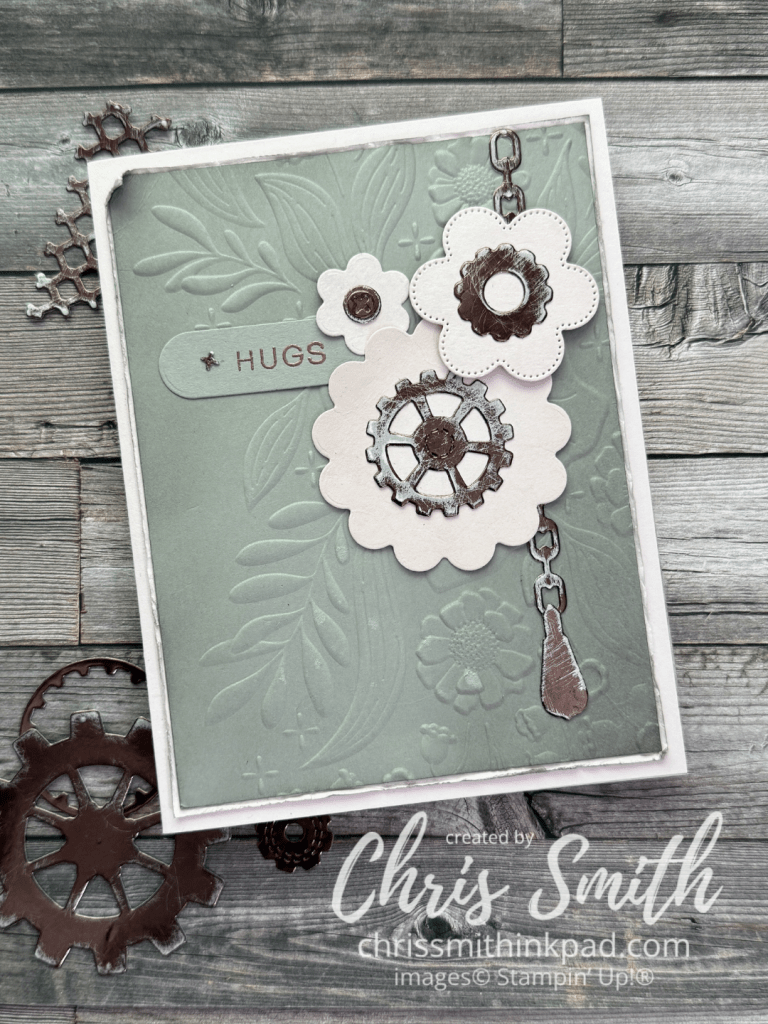
- I had trouble getting the Barely Blush and Gray Granite in the card to come through right in this photo but I love the way they worked together with the Earthen Toned Metallic – in real life!
- I lightly brushed Gray Granite ink onto the Gray Granite layer (3 7/8″ x 5 1/8″)before embossing it with the Floral Spray Embossing Folder. That piece is layered onto a 4″ x 5 1/4″ piece of Barely Blush before I roughened up the blush with my fingernail. I gave the edges another quick brushing of Gray Granite ink before rolling one corner and attaching it to a A2 (4 1/4″ x 5 1/2″) Barely Blush card.
- The scallops/flowers are die cut from Barely Blush with the Scalloped Blooms dies and brushed ever so slightly with the same color of ink.
- Most of the gear pieces were sanded as loose pieces but the chain was done in the negative piece that was left after making the die cuts. If you look closely you can see that the edges of the chain are more defined with the original Earthen Toned color. The others are more worn appearing at the edges.
Here is one that started with a piece of shiny gold metallic paper.
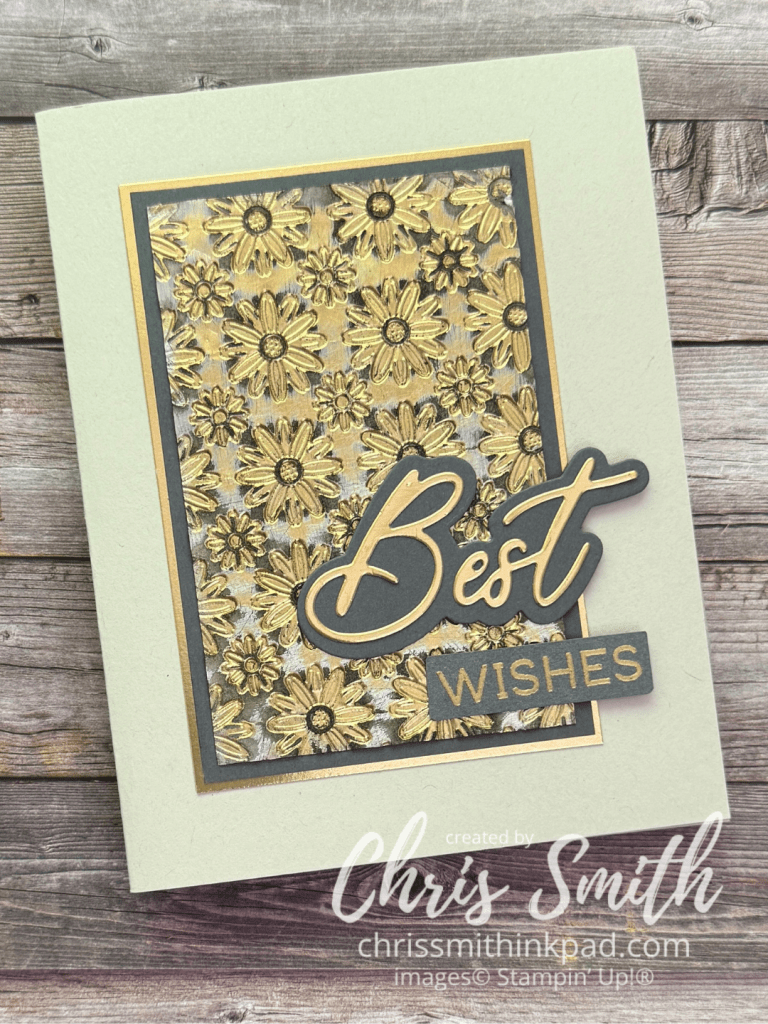
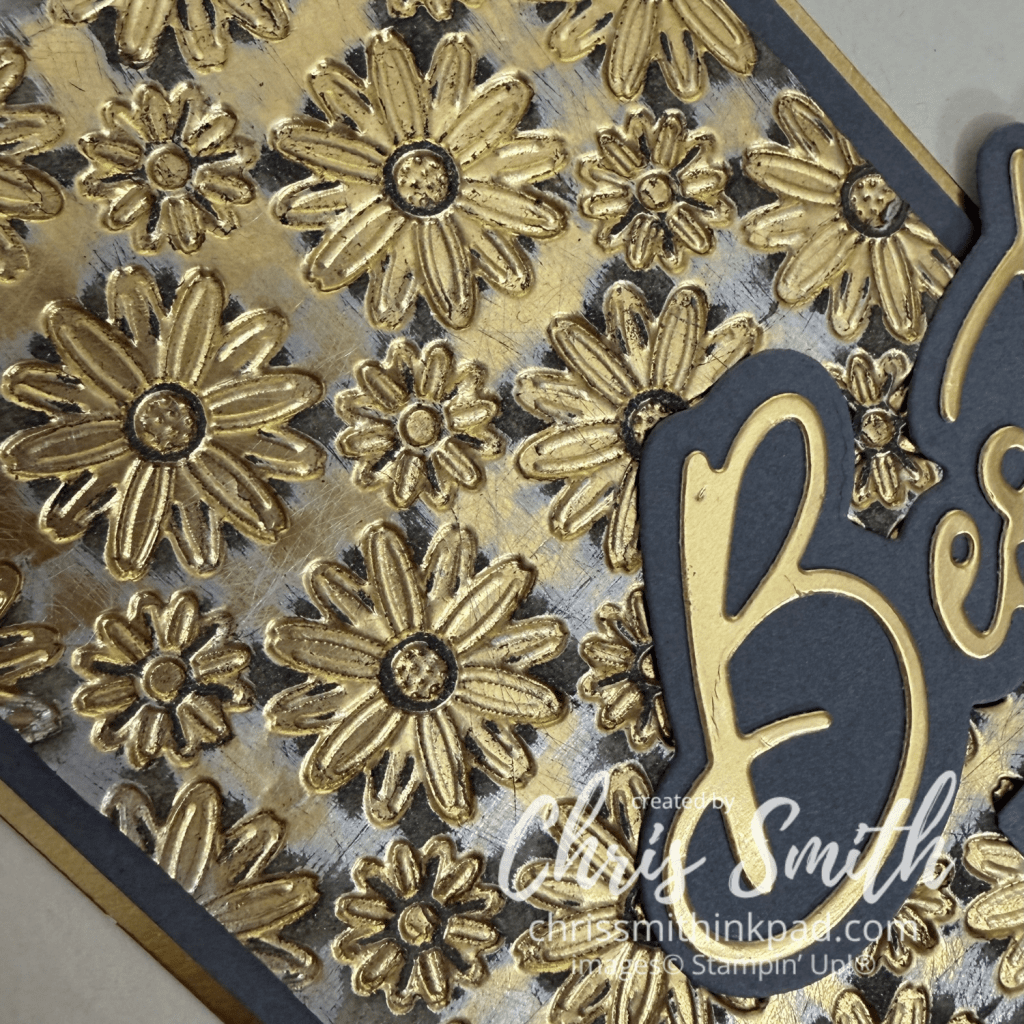
- I didn’t know what this would look like until I created the background piece but once I saw the way the pattern and colors work together I thought I would turn it into a card that was a little sophisticated and celebratory, like for a older couples wedding or maybe a retirement. You can see in the close-up at the top of the post that the piece shows gold that is roughened but not sanded off, a silver-ish color beneath it and then Basic Gray which is where I sanded down to white, uncoated paper that didn’t resist the ink like the gold and silver did.
- I think it is good to vary the width of your layers if you use more than 2. The Basic Gray border is 1/8″ while the unhanded gold metallic border is 1/16″. Actual Measurements: 2 1/2″ x 3 7/8 of embossed pattern, 2 3/4″ x 4 1/8″ of Basic Gray; 2 7/8″ x 4 1/4″ of unsanded Gold Metallic Paper
- When I have a design that won’t have an even border around the card I usually try to line it up so that the distance from the top and the sides of the card is the same with more space on the bottom. This time, since I knew that the words would extend towards the right edge, I made sure the left, top and bottom were equal distance and there was a little more room on the right.
- I like mixing the die cut words with stamped words from the Words & Wishes Bundle.
- I often just barely snip off the corners when I have a hand trimmed greeting such as “wishes”, just to slightly soften the edges. This time I also used my sanding block to smooth all the edges of this piece down. I’ll be using that trick again!
I hope you try sanding some of your metallic paper scraps at your craft desk! Here are some ideas to keep in mind as you experiment:
- There are lots of tools you can use to sand, even emory boards, I found a nice sized, very slightly cushioned, block at the hardware store for just a few dollars.
- Try different types of metallic or coated paper. You may find multiple layers and can experiment with how many layers you actually want to go through.
- Think about what colors of ink you might like to apply. Something darker to emphasize the metal color or maybe something complimentary? Always brush loose paper/dust off your sanded piece so that you don’t transfer the paper dust to your ink pad. You may not realize it at first but your sanding block may accumulate dust too so it a good idea to brush that off a bit if you can.
- Vary the way you swipe the sanding block across the paper or die cut. You will get different looks with straight swipes compared to using a circular motion.
- You can apply ink with blending brushes, daubers, or even directly from the ink pad.
- Save the negative from making die cuts and place the cut pieces back into the negative before sanding to get a different look. This preserves the metallic look at the edges, sanding more on the top surface. Without the negative you usually get the most of the metallic coating off of the edge.
- For variety, use both sanded and unsanded metallics in your final card design.
Now it’s time to check out what kind of sand the rest of our time got into. Next up is Bree Renwick:
Thanks so much for stopping by today. Please note that there is a gallery page index linked at the top of my blog. You can find samples from various Stampin’ Up sets and sometimes even techniques by checking the index. Chris


Leave a Reply